Saturday, August 15, 2026

A 2026 visit to Waverley Cemetery

 I had a chance to visit two cemeteries while on my quick visit of five days to Sydney. 

First was Waverley. While burials are indexed and available, there is not any strong evidence of whether or not headstones exist at each grave. While satellite image overlays of grave plots can now be helpful, they are certainly not definitive.

So I sat down and looked at posts where I'd referenced the cemetery, plotted out some names and grave locations. And on Tuesday I went for a walk with Matilda - we did the coast walk, with a solid diversion into Waverley cemetery on our way to Bondi. Here were my notes I created before heading out the door. The little dots below were a not-super-reliable area reference for me to start working off. As it turns out the cemetery web site map was outstanding and reliable.


And here was the view:


And now for the graves. One point to make up is that Waverley Cemetery search engine can tell you whether someone is buried at the cemetery, and the plot location in which they are buried. However, it cannot do the reverse and indicate ALL the people buried in a particular plot. And that can be valuable information that leads to new understanding about family connections, as I will reveal.....

1. Walter Herbert Hodge (1871-1956) - W-19-CE-OR-4587. My great-great grandfather and there's some information on him at this blog post (and more on other posts). Searching the page - in the same grave is his wife Grace nee SMITH (1870-1934) and their daughter Annie Victoria HODGE (1902-1904) who died aged 2. Significantly (see below) the undertaker for Grace and Annie was "W CARTER, Undertaker, Waverley". So this plot was likely acquired for Annie (1904).

There is NO HEADSTONE at this grave:

1. John MOLONEY (1841-1912) - W-18-RC-SL-3964. My great great great grandfather and there's some information on him at this blog post (and more on other posts). I knew there was a headstone at this grave from the work of other relatives including Hal Moloney and Tom Element, but here is the headstone - and it is beautiful:


There are inscriptions on two sides and are transcribed by me as follows:

In loving memory of Ellen Moloney, Native of Tower Hill of Limerick, Ireland 
Died Redfern N.S.W 27th June 1909, aged 67 years
Requiescat in pace
Also John Moloney husband of the above
Died 9th October 1912 aged 72 years RIP
John Michael McCarthy 25th March 1917 - 22nd July 1995
A quiet but generous man
In loving memory of Thomas James Element
Died 15th Dec 1977 aged 62 years In God's Care
Eileen Bridget Element 7 July 1914 - 12 July 1999
Their Love Lives On.

John McCarthy and Eileen Element were grandchildren of John and Ellen Moloney through their daughter Margaret. There were others buried at this plot without having information added to the impressive graave marker - including their son William MOLONEY (1872-1916).

3. Sebastian HODGE (1833-1899 - father of Walter above) - W-05-GE-SL-436. My great great great grandfather and there's some information on him at this blog post (and more on other posts). 


The double plot has stone borders, and a vase-type receptacle at the head of the grave. Searching did not reveal a fallen headstone, nor did it reveal evidence of a headstone ever being mounted at the grave. Confusing.

While I don't have a headstone, I do have a little research on who is buried in the plot. Sebastian and Ellen's son John Albert HODGE (1865-1892) is buried in the plot, but Sebastian's wife Ellen who died one year before him (1888) is not here - she was buried at Camperdown Cemetery.... this is because a year after his wife died, Sebastian married Helenor/Helena/Ellen MCBURNEY, and when Sebastian died THREE MONTHS after his second marriage, he came to be buried in Waverley. Why? Well, Helenor MCBURNEY's first husband Thomas McClelland died in 1884 (abt 1841-1884) and this plot is where he was buried... so it's likely his plot. When Helenor's second husband Sebastian died five years later, he was buried in the same plot. Eerie. Helenor married a THIRD TIME in 1905 to James Henry WILLIAMS (abt 1853-1934), then TWO MONTHS after her marriage she died - and was also buried at the plot in Waverley. So Helenor (1905) is buried with her first husband (Thomas, 1884), and her second husband (Sebastian, 1889).

That's complicated, but that research makes up for the lack of a headstone - and let's be honest that would be a complicated headstone!

4. Gladys SMITH (died 1999) - W-16-GE-SL-4047. I was interested in seeing if Gladys had a grave because of this photo of Gladys with her cousins including my great grandmother. And there was indeed a grave:


There are inscriptions on four sides, along with a tablet set in the ground, and are transcribed by me as follows:

In loving memory of Walter Carter 
Died 31st May 1914 in his 62nd year At Rest
Also of Eliza wife of the above Died 6th July 1934 in her 85th year At Rest
In memory of Walter Ernest Carter dearly beloved husband of
Frances Winifred died 16th June 1962 aged 56 years
Gladys Eliza Smith died 18th January 1999 aged 96 years
In loving memory of Hanson Carter died 8th June 1948 aged 70 years At Rest
Also Beatrice beloved wife of the above 
Died 13th November 1954 At Rest 
In loving memory of Annie dearly loved wife of William E. Smith
Died 9th October 1926, aged 52 years.
Peace. Perfect peace.
Also of William Ernest husband of above
Died 26th September 1944, aged 73 years, At Rest.

Gordon Smith died 21 September 2000 aged 88 years
Marjorie Smith died 25 December 2012 aged 84 years 


The family founded Walter Carter funerals, and daughter Annie CARTER married William Ernest SMITH. Eventually the business moved from son Hanson Carter's family to Gladys SMITH and son Gordon. This history I found online provides a wonderful summary:

"Walter Carter and his family arrived in Australia from England in 1883. Mr and Mrs Carter, their daughter Annie and son Hanson, found their first residence at Ultimo, Sydney. In 1884 the family moved to Woollahra and in 1887 Walter Carter established his funeral home.

Originally, the business was on a mere 17 foot frontage, but in a central location at Oxford Street, Bondi Junction. As time passed, both the company and the man grew in influence and experience. At one stage, Walter Carter himself served on the Waverley Council between 1897 and 1904, being elected mayor for two terms in 1901 and 1902.

After his death in 1914, the business passed to Walter's son, Hanson 'Sep' Carter. He was also a man of considerable note, particularly for his being Australian Test Cricket wicket-keeper from 1902 to 1921. In the early 1930s the transition from horse-drawn to motorised funerals took place. In 1939 a garage and two blocks of flats were built nearby in order to provide a place for the funeral vehicles and housing for company employees. Sep's love of cricket showed in his calling the flats Kennington and Old Trafford, which are the names of cricket grounds in England.

On his passing, the funeral home was left to his wife, Beatrice and son, young Walter, under the care of a trustee company. Beatrice died soon after (in 1954) and young Walter, who was not a well man, passed away in 1962 without having had any children. The business was passed on to Sep's sister's daughter and grandson Gladys and Gordon Smith but was, for a short while, still under the guidance of the trustees. Over the period of time from then until the present, the company grew."


Finally, on the ground at the grave was this decorated tile of Sep Carter. I was confused by it, but as the information above details, he was Australian wicket-keeper - and has a Wikipedia page with lots of extra information.


5. Mary PETRICH nee MOLONEY (1866-1847 - daughter of John MOLONEY above) -  W-12-RC-SL-4725. Mary information here and her husband Marino (1864-1914) are buried at this plot - there was no headstone - and much searching was performed to confirm it.

-----

OK that's Part 1. I hope this page provides information useful to other descendants. There are some loose threads here I've never fully chased down - particularly with Sebastian Hodge's second wife and her other two husbands... did they have children? Work to do.

I'll next provide a post on the Rookwood visit - which was shorter.

Wednesday, May 6, 2026

Glenwood, Glebe

I have an ancestor on my paternal side William STANILAND (1861-1917). William was one of my ancestors who was born in England, and emigrated to Australia. William was born in Whaplode, Lincolnshire in 1861 and grew up on the family farm. In 1881 he was employed at Long Bennington (Lincolnshire) as a 'groom' for General Practitioner/Surgeon named William Bell IRVING. Doctors need horses to 'do the rounds' and visit patients, and William's job appears to have been to maintain the horses, stable and possibly carriage. Irving died in 1881.

We don't know what motivated William to move to Australia, but he likely arrived in 1884 on the 'Sorata', and he married Ann SNAPE the following year in Sydney (1885). William and Ann had three children, and lived in Hereford St, Glebe, till moving to Bay St, Croydon around 1914.

There are only a few clues to what William's occupation was living in Glebe. In 1885 when he married Ann, William stated he was a 'gardener' living in Forest Lodge (adjacent to Glebe), , though I could purchase the birth certificates for his three children (1885, 1886, 1891) which would probably help. 

We have insight into who William worked for and where he lived. The 1897 New South Wales Police Gazette listed 'Watches and Jewellery Reported Stolen'. It states that on 15 Oct 1897, 'William Staniland care of Mr. Cary, "Glenwood", Hereford-street, Glebe' had stolen 'White metal watch, 'Patriot' on dial'. Newspapers covered the trial of the thieves - four young boys who attempted to escape police by jumping in the harbour to swim away. From these reports we learn a little more about William and Mr. Cary:

Evening News (Sydney, NSW)
Thu 21 Oct 1897

The four boys, Joseph Costello, 15, William John Redmond, 15, Arthur Phelps, 14, and Leslie Phillis, 13, who were on Monday arrested by Sergeant Gibbons and Constable Coleman, of the Glebe division, under somewhat sensational circumstances, were brought up at the Glebe Police Court to-day, before Mr. W. M. Macfarlane, D.S.M. They were charged with having stolen a metal watch and portion of a hair guard, valued at 10s 6d, the property of William Staniland, together with two corn bags, of the value of 1s 6d,

the property of Alderman Carey (Mayor of the Glebe). Constable Coleman stated that about 10.40 a.m. on Sunday, the 18th instant, he and Sergeant Gibbons saw the accused at the foot of Kennedy-street, Glebe. Withers told them that they were wanted in connection with a robbery. Costello immediately dived off the wharf into Johnstone's Bay, and was followed by the other three boys. They swam away from the wharf and remained in the water for an hour and a half. When they came out witness arrested them, and took them to the Glebe Police Station. They made no reply to the charge. 

William Staniland a gardener in the employ of Alderman Carey, stated that he resided in Hereford-street, Glebe. On the 15th instant he saw the four accused leaving the yard of Mr. Carey's premises. Witness had left his watch in the pocket of his waistcoat, which was hanging up in the stable. Witness shortly afterwards missed the watch and the two bags. He chased the accused, who threw the bags down and ran away. The watch had not been recovered. Constable Coleman stated that the police had received numerous complaints about the conduct of the accused, who were a pest to the neighborhood. 

The bench remarked that he did not intend to send the accused to gaol ; but hoped the course he was about to pursue would have the effect of making the boys respectable members of society. Costello, Redmond, and Phelps were ordered to be sent to the Carpentarian Reformatory for five years, and Phillis to the Sobraon.

Another article mentions that Staniland lost the watch and a 'hair guard'. This item was in fact an alternative to a fob chain, made of long hair, often that of a loved-one. 

So William was a gardener for William Cary (1831-1906, pictured). Cary was well-known in public circles at the time of his death - he emigrated young from England, trained as a 'modeller and ornamental plasterer', and is credited with inventing pressed cement ornaments (possibly the first to apply the technique in Sydney). He established the successful firm of William Cary & Sons, which operated on George Street South. The business prospered, and at the time of his death in 1906 Cary’s estate was valued at 162,444 pounds. Cary was also a long-time Glebe Alderman and Mayor. In one of those curiosities of genealogy - a maternal ancestor named Michael Joseph CONLON (also a Glebe alderman) attended Cary's funeral (revealed in newspaper coverage of the funeral).

In Glebe, Cary lived at 'Glenwood', a prominent home on Hereford street. We also learn from the articles referred to above (the 1897 theft) that William and his family likely lived on the Glenwood estate. The Glebe Society has some useful information on the estate.

Glenwood, image from around 1912 when Glenwood was in possession of the British Immigration League. It was ultimately demolished in the 1940s.

This c1890s plan shows how massive the estate was.... and suggests the gardening requirements would be large!

This 1876 listing of its sale describes the house as 'massive' and 'out-offices' include servants' rooms, range of staling, coachhouse, and man's room over. The property (all lots) totaled over 2 acres.


William Cary's widow Emma remained at 'Glenwood' till her death in 1912, and articles show that William had stayed in the employment of the family after William's death. 

The Sun (Sydney, NSW) 
Tue 7 May 1912
Probate has been granted in respect of the will of Mrs. Emma Cary, who died at her residence 'Glenwood', Hereford-street, Glebe, on February 8 last. Subject to bequests of 25 pounds each to her coachman, William Staniland, and her companion and nurse, Janet Graham, and 10 pounds each to two domestic servants, the deceased devised her estate to her 10 children in equal shares.


And we see here William listed as 'coachman' for Mrs. Cary, similar to his 1881 occupation of 'groom' in Lincolnshire. The house was sold after Mrs. Cary died, and William appears to have left service, and Glenwood. 

William and Ann Staniland relocated to Bay Street, Croydon where they must have purchased their home. We know when they moved because Electoral Rolls show that in 1912 they were in Hereford St Glebe, and in 1914 they were residing in Bay St, Croydon. 

We can guess that their home in Croydon was purchased (and quite newly built) as in 1917 William Staniland died quite young, aged 56, of kidney failure at Western Suburbs Hospital (which no longer exists). At the time of his death, William had by necessity moved to a new occupation, as a 'shop assistant, clothing'.

The funeral notices for William state the the funeral party would depart from his home:

Glenwood, Bay-street, Croydon

Thursday, November 28, 2024

Margaret PIGRAM, bigamy (!), and her husband Richard HOSIER.

 My immediate past post was providing some information on the third of three wives of Thomas Trevithick. Over ten years ago I wrote a post identifying where Margaret PIGRAM, Thomas' second wife, came from. Thanks to some recent emails with a fellow descendant I've decided to update that original post with new information, particularly regarding Richard HOSIER.


Thomas Trevithick, born Truro, Cornwall, migrated to Victoria then travelled to and finally settled in Hill End, NSW. He had three wives as described previously (http://thehistoryofmatt.blogspot.com/2008/12/wives-of-thomas-trevithick.html).

While I knew fairly comprehensively about Thomas' first wife Elizabeth Randal CANDY (my ancestor, died 1871) and his third wife Mary Ann GREEN (married 1900, died 1949), I knew very little of his second wife, Margaret Hosier.

What I did know came from the Hill End Family History Register. It records their marriage as:
10 Sep 1881
St Andrews Hill End
Spouse Margaret Hosier (widow nee Pigram)
B Bishop Stortord ENG (THIS IS INCORRECT)
D 12 Apr 1892 Hill End
Parents: Joseph Pigram*
Bur Tambaroora

I do not know where the in information in the 
Hill End Family History Register came from, but assume it was from her death certificate (which I do not have). Their marriage certificate of 1881 revealed little useful information, other than that Thomas' son Thomas (Jr.) and daughter-in-law were witnesses. Apart from Margaret HOSIER being a widow (which will be important later), no other biographical information was recorded on her. Her occupation was listed as 'lady' suggesting that rather than working she may have been of independent means.


Transcript:

NSW Marriage certificate
Date and place of marriage: 10 September 1881, Hill End

Husband
Name and surnames of parties: Thomas Trevithick
Conjugal status: Widower
Birthplace: -
Usual occupation: Blacksmith
Age: -
Usual place of residence: Hill End

Wife
Name and surnames of parties: Margaret Hosier
Conjugal status: Widow
Birthplace: -
Usual occupation: Lady
Age: -
Usual place of residence: Hill End

Married in Hill End, according to the rites of the Church of England

This marriage was solemnized between us:
Thomas Trevithick
Margaret Hosier, her X mark

In the presence of us
Thomas Trevithick
Sarah Trevithick


By me Josiah ?, Officiating minister


While I could not read the name on the certificate, Josiah is Reverend Josiah Kimberley, who was stationed there from 1881-1883.

------------

Using marriage records in London and immigration records in Australia I have now traced Margaret back to England. I will present her information in chronological order (rather than in the reverse chronology that I uncovered this information in). To summarize, Margaret was born about 1822 - her birthplace seems to be conflicted, however I believe it was in London Middlesex (Holloway district) based on Margaret's own records shown below. Note that Bishop Stortford was probably erroneously put forward because a Margaret, daughter of Joseph was baptised there in 1825 - but there were two Joseph's of that name (at least homophonic to PEGRAM) in England.

I've now found Margaret's baptism in 1821 at St Mary, Islington.

Transcript:
Margaret, Daughter of Joseph and Charlotte Perrigam
Residence: Back Road 
Father's occupation: Labourer 

The first definitive record is Margaret's marriage in 1840 to George WRIGHT, that reveals Margaret's father as Joseph, that she was young when she married (under 21), and that her father and (probably) step-mother were witnesses. 

Transcript
1840 Marriage solemnized at the Parish Church in the Parish of St Leonard Shoreditch in the County of Middlesex
No. 172
When married: 22 March 1840
Groom:
George Wright, of full age, bachelor, labourer
Residence Holloway, Father Jas Wright deceased, card maker
Bride:
Margaret Pegram, minor, spinster, laundress
Residence Holloway, Father Joseph Pegram, labourer
Married in the parish church according to the rites and ceremonies of the Established Church after Banns by me John B Williams Curate
Solemnized between us: George Wright and Margaret Pegram (both signed)
In the presence of us: Joseph Pegram X his mark and Susan Pegram X her mark


WRIGHT is a common name, and I haven't found George and Margaret in the 1841 census, but the 'other' Margaret PEGRAM in Bishop Stortford appears with her family, unmarried, reinforcing that that person should be excluded as the candidate. Many George WRIGHTs died in London over the next ten or so years, so it isn't possible to tell when he died, but Margaret's next record was again a marriage in London in 1849 as a widow, to Richard HOSIER.

Transcript
1849 Marriage solemnized at the Parish Church in the Parish of St Leonard Shoreditch in the County of Middlesex
No. 104
When married: July 15
Groom:
Richard Hosier, of full age, bachelor, labourer
Residence Brand Street, Father John Hosier, labourer
Bride:
Margaret Wright, full, widow, laundress
Residence Brand Street, Father Joseph Pegram, labourer
Married in the parish church according to the rites and ceremonies of the Established Church after Banns by me
Solemnized between us: Richard Hosier and Margaret Wright (both signed)
In the presence of us: Joseph Pegram X the mark and Ann Carter X her mark


In the 1851 census, Richard and Margaret were living on George's Place in the village of Holloway, Parish of Islington, District of St James Holloway, City/Borough of Finsbury in London. Richard was 28, a brickmaker, born in Camberwell Surrey, and Margaret was 29, a Laundress born Islington, Middlesex. It appears that neither marriage produced issue.

1851 Census for Richard and Margaret HOSIER

Margaret's father can be found in the 1841 and 1851 census (where he has re-married). In 1851 they live in Brand Street, Holloway. Holloway is where both Margaret's marriages in London occurred and her stated address in her 1849 marriage. Parents Joseph (48, a ground digger) and step-mother Susan (40, charwoman) PEGGRAM, both born in Holloway, Middlesex. With them are children Maria (8), Mary A (6) and Frederick (18).

In 1856 the ship 'James Fernie' brought passengers to Moreton Bay (in what is now Queensland), having left Gravesend, London in October 1855
. On that ship were Richard and Margaret HOSIER as assisted immigrants. Two separate immigration indents exist, this one conveniently has them at the top of the page and supports the information above:

Transcript:
List of Immigrants per Ship James Fernie as inspected by the Immigration Board on 6th January 1856
Married
Hosier Richd, Age 32, Occupation Brickmaker, Native place Surrey, Parents John and Sarah (no address given so presumed deceased), Religion C of E, Read or write: little.
Hosier Margt, Age 33, Native place Islington, Parents Joseph and Charlotte Pegram, father living Islington, Religion C of E, Read or write: little.

After this, I've found very little trace of them the Australian colonies till Margaret's marriage to Thomas Trevithick in 1881. In a way this makes sense - law abiding people without children don't have many opportunities to create 'records'. But there are two items where we find Richard HOSIER.

After their arrival, they must have moved towards Sydney fairly quickly, as New South Wales Gaol Entry Records for mid-1859 show a Richard OSIER , along with Henry OSIER (birth records in London suggest it's his younger brother). They were arrested for 'stealing oranges' and spent two weeks in gaol. I cannot find a newspaper record related to this. The two separate entries confirm it is "our" Richard HOSIER as he states he arrived on the 'James Furney', was born in Surry, and is a brickmaker by occupation.


A collage of a wide piece of paper showing gaol descriptions for Richard Hosier and his putative younger brother Henry.

The next entry for Richard is AFTER Margaret's marriage as a widow to Thomas Trevithick in 1881.... 

In 1884, Richard entered the Macquarie Street Asylum, Parramatta.

Macquarie Street  Asylum in Parramatta, circa 1880. Local Studies  Photograph Collection LSOP 114 (from https://historyandheritage.cityofparramatta.nsw.gov.au/blog/2014/06/27/macquarie-street-asylum-parramatta-part-one)

The 'Register of Inmates, Government Asylums for the Inform and Destitute' has an entry for Richard Hosier entering the asylum. Under 'history' the entry states "Came to the colonies 30 years ago from Islington near London. By trade a brickmaker. Has worked at his trade and on the railways for a living. Has been unable to work for the last 5 years owing to rheumatism. Widower for the last 16 years."


So this is clearly the correct Richard HOSIER, three years after his wife married Thomas TREVITHICK. No other death records have been identified at an earlier date for Richard.

The only death certificate for a Richard HOSIER is consistent with the Macquaire Street Asylum (Parramatta) information, and was recorded in 1891, ten years' after Margaret's marriage to Thomas TREVITHICK:


New South Wales 11970/1891
Death Certificate
Date and place of death: 1891 12th March, Macquarie St Asylum 
Name and occupation: Richard Hosier, unknown
Cause of death: Chronic diarrhea
Medical attendant and when last saw deceased: Wm Bradley Violette 12th March 1891
Sex and age: Male, 76 years
Parents: Unknown
Informant: Certified by Brooke, Macquarie St Asylum
Registered: 13th March 1891, Parramatta
When and where buried: This body was in the first instance sent to the Anatomical College
Where born and how long in the Australian Colonies or States: Islington, London, England, 30 years
Place of marriage, age and to whom & children: Unknown

I've never seen a death certificate noting that the body is directed to anatomical research. As a side-note, fellow researcher Garrie Ellice has pointed out that the burial record for Rookwood Cemetery in Sydney where Richard was buried lists a burial date of 23 May 1891 - about two months after death (and use in medical school) before internment. This was a paupers grave with no headstone, and three others were buried in the same grave: Manfred Bulsham (bur 19 Apr 1890), James Wardrop (bur 25 Sep 1906) and Uranie Wilson (buried the same day as Richard - 23 May 1891)

Why are there no other records, no newspaper notes for either of Hosiers in Australia? They didn't have children, were mainly law abiding, and didn't own property - so there aren't many opportunities to see them in records.  There are probably a few things that aren't transcribed that will emerge.... time will tell. 

Richard's death certificate for 1891 would suggest Margaret was - knowingly or unknowingly - a bigamist when she married in 1881. I have not shown or found any documentary evidence of Margaret's movements in Australia, and whether or not she was with Richard Hosier for long after they arrived in Australia. Both Richard and Margaret state their spouse is deceased at different points.

Clearly Margaret and Richard had gone their separate ways. Hill End is a long way from Sydney, and I don't think there was much risk of being 'found out' as a bigamist. Given that Margaret and her three husbands never produced issue, this is likely the only work that's been undertaken tracking the life of Margaret PEGRAM, and her first two husbands.

Monday, November 25, 2024

The marriage certificate of Thomas Trevithick of Hill End to Mary Anne Green.

 An email from a fellow researcher prompted me to post the marriage certificate of Thomas Trevithick and Mary Anne Green As can be seen, Mary Anne is nearly 40 years younger than Thomas. While they did not have children together, Mary Anne brought a child Winifred Green to the marriage.


NSW Marriage certificate
Date and place of marriage: 14th March 1900, Hill End

Husband: Names and surnames of parties: Thomas Trevithick
Conjugal status: Widower
Birthplace: Cornwall, England
Usual occupation: Miner
Age: 66 years
Usual place of residence: Hill End
Father's name: William Trevithick, deceased
Mother's name and surname: Ann Allen, deceased
Fathers occupation: Blacksmith

Wife: Names and surnames of parties: Mary Ann Green
Conjugal status: Spinster
Birthplace: Sofala, N.S. Wales
Usual occupation: -
Age: 28 years
Usual place of residence: Hill End
Father's name: Thomas Green
Mother's name and surname: Rosanna Bryson
Fathers occupation: Miner

Married in Mr Trevithick's house, Hill End
According to the rites of the Church of England

This marriage was solemnized between us
Thomas Trevithick
Mary Ann Green

In the presence of us
Tom Green
Mary Ellen Isabel Murray

By me, Stephen James Wilson, officiating minister


-----

While Thomas died in 1913, Mary Anne died in 1949 (in the same town her daughter lived in), and is buried at Rylestone General Cemetery.


Mudgee Guardian and North-Western Representative
Thursday 27 January 1949
Mary Anne Trevithick
The death occurred at the residence of her daughter, Mrs. H. Carl, on .January 15, of Mary Ann Trevithick. Deceased was born at Sofala 78 years ago, but spent most of her life at Hill End and Kandos. She. had dwelt for the past 23 years, in the last-named centre, and was held in very high esteem for the past two years. The remains were interred in the Methodist portion of the Rylstone Cemetery. Rev. Dixon carrying out the last sad rites. Deceased is survived by her daughter, Mrs. Carl, of Kandos, to whom we extend our deepest sympathy.


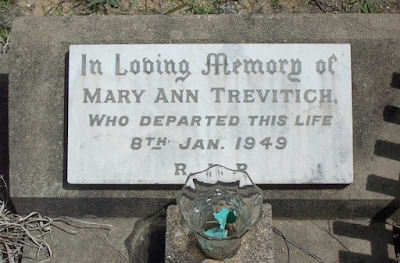
Rylstone General Cemetery
In Loving Memory of
Mary Ann Trevitich
Who Departed This Life
8th Jan 1949
RIP


Tuesday, January 9, 2024

An update - What happened to Maureen D HALL. Born 1930, Young/Koorawatha NSW

This is an update (finally!!!) on my search to find what happened to Maureen D HALL. 

 Among my HALL ancestors, William HALL (1843-1912) and Eliza BLISS (1852-1925) had 15 children from 1868-1896 all registered in Yass NSW. They later relocated to Koorawatha NSW, and from time to time I update this post series on the fate of each HALL child: https://thehistoryofmatt.blogspot.com/2018/03/the-children-of-william-and-eliza-hall.html (on that page my ancestor is Alfred Ernest HALL),

One of those 15 was Walter Henry HALL (1893-1950). In WW1 he served in B Company of the 45th Battalion AIF and was wounded in France. Afterwards he returned to Koorawatha and became a postman, dying in Concord Hospital (a suburb of Sydney, and a hospital for returned servicemen) in 1950 after finally losing his leg, and is buried in Rookwood Cemetery nearby. 

Walter married Marjorie A DONGES (1902 Young - 1930 Young) in 1928. Frank Hall (my grandfather's brother and a chemist at Wollongong University) dove into both the records and drove around NSW finding relatives to compile a HALL family history. The marriage for the pair was reported in the local papers:

 The Young Chronicle

Tue 18 Sep 1928


Of Walter he wrote the following (name of wife not correct, as noted above). Keep in mind this was written by in the 1980s by someone born in the 1920s, so the word choice is not up to 2020 standards:

"Walter H. He married Madge Dawson of Young quite late in life. He lived much of his life in Koorawatha of course operating at one time as a postman. His wife died at childbirth having a sub-normal daughter Maureen. To my knowledge she was still in a mental home at Stockton Newcastle in 1987."

Ever since reading this over 15 years ago I've wondered what happened to Maureen. It appears that almost immediately after birth, Maureen was placed in 'care'. This is a complex set of institutions at a time in Australia when 'mental hospitals' and institutionalization was standard practice, when the Indigenous stolen generation mechanism was well underway, as was the forced emigration of English orphans into Australia.

In 1987, aged 57, Maureen was still alive. But what was her fate? Who visited this only child after her father died in 1950? What was Maureen like? Where is she buried? I have a lot of questions.

Maureen's birth certificate isn't available, as she was born in 1930 (and there's a 100 year restriction in NSW). But I could confirm her name from her mother's death certificate:


NSW Death Registration 1930/17029
Name: Marjorie Alma Hall
Date of death: 7 Oct 1930
Place: Sacred Heart Hospital, Campbell St, Young ; late of Koorawatha
Sex: Female
Age: 27
Place of birth: Monteagle NSW
Father's name: John Christopher Donges, Farmer
Mother's name: Emma Simmons
Place of Marriage: Cowra NSW
Age at Marriage: 25
Name of Spouse: Walter Henry Hall
Children of Marriage: Maureen D, 9 days, living ; None deceased
Informant: W H Hall, Widower, Koorawatha
Cause of Death, length of illness: Chronic nephritis, myocarditis (12 days)
Medical attendant: A J Maurice Purchas
Date last seen: 6 Jan 1930 (I suspect this is mis-transcribed)
Date of Burial: 8 Oct 1930
Place of Burial: Church of England Cemetery Young
Minister and Religion: K L McKeown, Church of England
Undertaker: Patterson Bros
Witnesses: Frank Leach, Cecil T
Registered: 8 Oct, 1930 - Young


So Maureen was 9 days old when her mother died, and if the narrative is correct, she was placed in state (or religious) care. Possibly this was initially in the Young area, but the 'Stockton Mental Hospital for Children' was well established by 1941. My heart breaks thinking of Maureen, alone, and far from the HALL family base in Koorawatha (there were none in the Sydney or Newcastle areas), but clearly some extended family awareness of her location in 1987.

Newcastle Sun, 6 May 1941


In Jan 2020 the Property Officer - Cemeteries at City of Newcastle kindly checked the burial records for Stockton Cemetery, Wallsend Cemetery, Minmi Cemetery, and Sandgate Cemetery but no record of a burial for Maureen Hall could be found. 

As time has gone on I've continued to search all records each year as records are released - death certificates in NSW are released after 30 years. I've now found Maureen's likely death. The certificate in transcribed below. It doesn't reveal a great deal, but ties back to Maureen - father Walter, and born in Koorawatha. It states that Maureen passed away in late 1993, and lived at "Fairlegh Park" in Armidale NSW. Armidale is on the far north coast on NSW, a very long way from Koorawatha. Note that Maureen died in December 1993, but her death wasn't registered till February 1994.

My next job is to understand what 'Fairleigh Park' was. It now appears to be a Crematorium and memorial park.


NSW Death Certificate 4125/1994
Name: HALL, Maureen
Date of death: 8 Dec 1993
Place of Death: "Fairleigh Park" Uralla Rd Armidale NSW 2350
Sex and age: Female, 62 years
Place of birth: Koorawatha, NSW
Period of residence in Australia: Life
Place of residence: "Fairleigh Park" Uralla Rd Armidale NSW 2350
Usual occupation: Home duties
Marital status: Never married
Children: Not any
Mother's name: Maureen
Mother's maiden name: Not known
Father's name: Walter HALL
Cause of death: Carcinoma vulva 17 months
Name of certifying practitioner: Dr. B. H. Connor
Burial or cremation, Date: 9th December 1993
Place: Lawn cemetery Armidale
Informant: M J Field, "Fairleigh Park", no relation


Monday, September 27, 2021

George Bliss' family in Kent - their fate?


My ancestor George Bliss (1819 Otford, Kent, England - 1915 Yass, NSW, Australia) was a convict transported to New South Wales for life.

I've previously written several posts, including:

One topic I haven't had a chance to explore was that of George's family - who were his parents and his siblings? Did any other family come to Australia? We know there were others named BLISS transported to Australia, for example. I did identify George's parents and siblings in a post, showing they were from Otford and Seal in Kent (two adjacent villages). 

In this post I'm going to outline George's parents and siblings, highlight what I don't know (and can't solve) about George's family, and introduce an exciting new discovery: George Bliss had a brother who was also a convict. I've also tried to display as many of the primary records as possible in this post, to make it clear what I have documentary evidence for.

Based on what I've pieced together, here is George's family and what I've determined so far. I've intentionally shown George's mother Elizabeth nee HOLLOWAY to highlight that she married a second time.


George's Parents

Richard Bliss (1770-1824) was born about 1770, origins unknown. The first record of Richard is his marriage on 2nd Dec 1810 in the village of Seal, Kent, England, to Elizabeth Holloway. The parish entry does not record whether Richard was a bachelor or widower, but it is estimated he was 40 years of age at marriage.

Seal, Kent marriages, 1810

Richard Bliss of this parish and Elizabeth Holloway of this parish were married in this Church by Banns this second day of December in the year 1810 by me William Humphrey Vicar. This marriage was solemnized between us Richard Bliss (Mark of) Elizabeth Holloway (Mark of) in the presence of William Austen (Mark of) R Walter.


Over the next nine years Richard and Elizabeth had four children, all baptized in the villiage of Otford, Kent (immediately adjacent to Seal):


  • Ellenor Bliss, baptised 22 Dec 1811
  • John Bliss, baptised 20 Feb 1813
  • Eliza Bliss, baptised 1 Dec 1816
  • George Bliss, baptised 21 Feb 1819

All four children were born to Richard and Elizabeth BLISS. The latter three entries in the parish records (using new standard parish books implemented ~1812) list the Bliss abode as 'Otford'. Richard's occupation was baker in 1813 but changed to labourer for 1816-19.

In the first cold weeks of 1824, Richard died aged 54, and was buried at Otford. Is is this parish entry for Richard that establishes his year of birth around 1770.

Otford, Kent burials, 1824 - 1824 Richard Bliss, Otford, buried Jany 14th 1824, aged 54

Richard does not appear to have a headstone. About nine months following Richard's death, his widow Elizabeth BLISS nee HOLLOWAY married again at Otford church. Of note, her daughter Eleanor Bliss (aged ~13) was a witness:

Otford, Kent marriages, 1824

John Austin of this parish widower and Elizabeth Bliss of this parish widow were married in this Church by Banns this 27th day of September in the year 1824 by me Thomas Hayman. This marriage was solemnized between us the x of John Austin the x of Elizabeth Bliss in the Presence of the x of John Owen the x of Eleanor Bliss.


Elizabeth and John AUSTEN do not appear to have had children, unsurprising given that Elizabeth was ~40 when she entered this marriage. The Seal, Kent parish register shows that John AUSTEN was buried on 1st June 1845, aged 66 (so John AUSTEN was born abt 1779), with his abode being listed in the burial register as 'Seal Chart'. Seal Chart is a distinct village immediately to the east of Seal. At the time, Seal Chart church was established in 1868, so it seems likely that Seal was the parish for burial. John's death in 1845 also opens a window to possibly find John and Elizabeth AUSTEN in the 1841 England census ; while there is a John AUSTEN living in Godden Green near Seal, I haven't found a good match yet for John and Elizabeth in 1841.

I have had better luck in the 1851 census, where Elizabeth AUSTEN appears, in the census entries for Seal, Kent. Elizabeth AUSTEN, living at Seal Chart, the head of a household, a 65 year-old widow, and occupation listed as Char Woman. In the entry for 'where born', Elizabeth's birthplace was listed as "Hampshire, M...?", but I cannot identify the village listed. Living with Elizabeth was Olly Gasson, a 74-year old widow and pauper originally born in 'Ockenden, Essex'.

   1851 Census, Seal, Kent

Elizabeth appears again in the 1861 census, now living in the hamlet of Godden to the immediate south of Seal. Elizabeth was entered as a lodger and widow aged 76. Elizabeth's occupation was listed as 'formerly labourer's wife' and her place of birth was entered as 'N.K.' (not known). 

   1861 Census, Seal, Kent

Elizabeth's burial is recorded in Seal's parish records, buried on 21 Mar 1865 aged 81 (so born about 1784) with her residence at death recorded as The Union Workhouse. Workhouse records - probably the Sundridge workhouse that served the Sevenoaks district - may reveal more.


---------


The children of Richard and Elizabeth BLISS. What became of each of the four children? One of course is George BLISS my ancestor, who was transported to Australia, but I've recently spent some time trying to determine the fate of George's siblings. There's a lot more work to do, but I had a major breakthrough with George's brother John, was also a convict, bit with a very different fate!


Ellenor BLISS, baptised 22 Dec 1811
Ellenor was born 1811, and was a witness at her mother's wedding to John AUSTEN in 1824 (aged around 13). This is the last definite record I have for Ellenor. On 26 Sep 1836 an 'Eleanor Bliss' married William TURNER at Cudham, Kent, but I am yet to further trace Ellenor and confirm her marriage.

John Bliss, baptised 20 Feb 1813
John was born in 1813. The first we hear of John is a note in the 'Maidstone Journal and Kentish Advertiser' of "Prisoners Committed to the County Gaol.... John Bliss felony at Otford". The Criminal Register for Kent indicates that John was tried at the Michaelmas Session for 'Larceny by a Servant' and sentenced to 6 months. While there is an eight-year gap  


South Eastern Gazette - Tuesday 24 September 1839 
HORSE STEALING - APPREHENSION OF THE THIEF - On Thursday night last a horse was stolen from the farm-yard of Mr. B. Wickham, Goodhurst. Information having been received that a horse which had been stolen from Mr. Mannering, about a fortnight since, had been seen in Essex, in the possession of John Bliss (alias "Sevenoaks Jack"), a desperate character, Mr. T. Wackham and several other persons, thinking it probable that his horse had been similarly disposed of, went in pursuit, and found that a man had crossed the ferry with a horse answering the description of his own. Mr. T.Wickham traced him about thirteen miles, and found that it was as he expected - "Sevenoaks Jack" with the stolen horse. He seized the robber by the collar, and told him that he was his prisoner. "Jack" replied "Oh then, I'm done now." He had when taken a loaded pistol in his pocket. He is now in Chelmsford gaol.


Chelmsford is in Essex, north across the River Thames from Kent. For this reason, record searches had not identified this John Bliss as being from Seal, Kent. However, the articles above makes the connection between John committing a crime Otford, and in time becoming "Sevenoaks Jack". He was retained in Essex, and there tried and found guilty. John BLISS' defense received detailed coverage in a newspaper, and provided a great deal of detail about the crime.

Chelmsford Chronicle - Friday 06 March 1840
John Bliss, aged 26, described as a tanner, but having the appearance of a labourer, and who evinced considerable shrewdness in cross-examining the witnesses, was indicted for stealing a mare, value 34 pounds, and a set of harness, the property of Benjamin Wickham, of Goudhurst, Kent - Mr Espinasse stated the case for the prosecution.


West Kent Guardian - Saturday 14 March 1840
Horse-stealing.—At the Essex Lent Assizes last week, John Bliss, (26) described as a tanner, and well known by the cognomen of "Seven Oaks Jack," a shrewd and daring character, was indicted for stealing a mare, value 34 pounds, and one set of harness, the property of Mr. Benjamin Wickham, farmer, of Goudhurst, Kent. Mr. Espinasse stated the case, and called Mr. B. Wickham. I am a farmer at Goudhurst; the 19th of September last I saw the mare in the stable between six and seven at night. It was missed the next morning, and I saw it again at Rainham, together with a set of harness which I knew to be mine. 
    Thomas Wickham.—l am the son of the prosecutor, and on the 20th of Sept. I went in pursuit of the mare to Gravesend, where, in consequence of information I received, I crossed into Essex, and went into Rainham; Mr. Travers was with me; we went to the Bell, and found the prisoner and the mare there; they were both in the stable ; I saw a set of harness there, which I thought belonged to father. I knew the mare directly I saw her, for my father bred her ; she is about seven years old. I had known the prisoner before, and when I saw him in the stable he asked if I first heard of him at Cobham, and whither I walked to Rainham. 
    Prisoner: Did I ask you whether you came through Cobham , or whether you heard of me at Cobham ?—Witness: You said—Did I hear of you at Cobham.—When you saw me was in the stable, or standing half in and half out ?— You had one leg in and the other out. —How many people were there my company ? —There was not any one in the yard; I collared you, and said, " You are my prisoner."— Who put the mare in the stable ?—I cannot say ; I didn't see her put the stable; the ostler was just coming with a feed of corn for it, and you were at the stable.—Could you see all over the stable?—lt was a small one, and I think I could. —How many stalls were there ?—I think three or four.— Then could you see all over it ?—I think I could—the mare, I think, was in the centre.—Now upon your oath, was I the man that put it there ? There was a man who put it there in the stable.—l did not see him.—You could not see all over the stable. There was a man lying under the manger.—l don't believe it; I didn't see him.—Who ordered the corn? —That I cannot say.—Where did the ostler Come from?— From the back part of the house?— The man that belonged to the horse, was he in doors, then, order this feed of corn ?—I cannot say; you are the man described to along the road.—Who described me ?—The man at the Ferry. 
    Edward Travers.—l keep a public-house at West Tilbury ; on the 20th of September I went to Rainham, I and the last witness, taking different roads; I saw the prisoner at Rainham, and he had the mare with him ; I saw him in the yard of the Bell, the head of the horse being in the stable, and he was in the act of driving it in; I saw no other person with her she had harness on. Mr. Wickham then came up, and we went and collared him. 
    Prisoner: Have you stated the same as you did before the magistrates ?—Witness : I have to the best of my knowledge.—Prisoner : l am sure you have not. You stated about the same as Mr. Wickham, if you recollect. The depositions were then read over to the prisoner, and he declined putting any other question. 
    John Everett.—l am constable of Rainham ; and on the 20th of September I saw the prisoner about half a mile from that place, with a horse and harness, going there; it was about one in the afternoon. I afterwards saw him at the Bell, and a horse was shown to me, which I believe I can positively swear was the same horse I saw him with before. The horse and harness were afterwards shown to Mr. Wickham in my presence. I took the prisoner into custody. I asked him if he had any unlawful weapons about him, and he said he was sorry he had one—it was a pistol, and was loaded with slugs. He said it was a bad job, and he was sorry for it. I asked him how he came to take the mare away, and he said he was persuaded to do it by another man he had been drinking with him at a beer-shop two days before he took it. He added, that the night he took the mare away he laid in the shed in the yard where the mare was, till morning, and that another man harnessed the mare and brought it out of the yard; but he then took it of the man, and they parted. It was between twelve and one when he left Goudhurst; and he had to go a great way round to avoid the turnpikes. 
    Edward Apps. I live about a mile from the prosecutor, and have known the prisoner five or six years. About seven or eight o'clock on the evening of the 19th of September, I met him going from the turnpike-road, in a direction to Mr. Wickham's stable he was about half a mile off.          
    Prisoner : Where was it you met me ?—Witness: Just by the water-mill.—Prisoner : Was it light ?—Witness : Not very, but it was light enough to know you. Mr. Wickham, sen., re-called, and identified the harness. The prisoner in defence said, he was a watchman on the railway, and having a holiday, he took the pistol with him from the station-house in the morning; he had to fire it off at 6 o'clock every morning, and the gentlemen of the railway knew he had it. The pistol was not meant for destruction at all. 
    Mr. Justice Littledale : The pistol has been introduced incidentally, but you are charged with stealing a mare—do you wish to say anything on that? 
    The prisoner said no. 
    Mr. Justice Littledale summed up the case, and said if the charge was that highway robbery or attack, the pistol might have something to do with the case, but it was not the sort of thing a person who meant to steal a horse usually took with him. 
    The Jury found the prisoner guilty. 
    The sentence was deferred, and when brought up the next morning the prisoner begged for mercy, observing that if he had been sentenced the night before he could have had a two years' character, but the gentlemen who would have given it were compelled to return to London. 
    His Lordship said, formerly persons were actually executed for this offence, but it was now reduced to ten or fifteen years' transportation ; he felt it be his duty in this case to inflict the full punishment. 
    The prisoner, in an affecting manner, implored for mercy. His Lordship paused, and then said—Well, the sentence is that you be transported for ten years. The prisoner expressed his thanks for this lenity.


The map above highlights the locations mentioned in the articles above. John Bliss was from 1. Seal (and committed his first recorded crime at Otford). The horse was stolen from 2. Goudhurst, then ridden north avoiding turnpikes, till arriving at 3. Gravesend (and passing through Cobham). At Gravesend, John Bliss took the horse across the Thames River on the ferry into Essex, then headed west till arriving at the Bell hotel in 4. Rainham. This is where the horse owners eventually caught up with him.

And so, John Bliss was convicted to 10 years transportation. This sentence was not to New South Wales like his brother, nor any other Australian colony. Instead, he was transported to Bermuda. Bermuda was an entirely different punishment ; it was not a penal colony, with convicts living aboard anchored hulks, and employed in building the Royal Naval Dockyard on Ireland Island. Those transportees that survived their period of punishment were returned to England.

John was placed on the prison hulk HMS York (at Portsmouth), and he is recorded in the York Hulk Register:

No. 9083, John Bliss, age 26
Convicted of horse stealing, sentenced 2nd March 1840, Sentence 10 years
Trade: Tanner, Gaoler's report: Not known
How disposed of: P Horatio, Bermuda, 18 July 1840

After a brief period in the hulks, John appears to have sailed to Bermuda in July 1840. Others on the same page of the Register were transported to New South Wales or Van Dieman's Land, but young & strong convicts were reputed to be selected for the back-breaking construction tasks of Bermuda. Once in Bermuda, John was transferred to the hulk Dromedary:


John was based on the hulk by night, and moved to land to build the dockyard by day. 

John survived two years in Bermuda. The prison hospital records in Bermuda show that John suffered from dysentery in July 1841 (as did many convicts in Bermuda), and 'made a good recovery'. A year later, on 3rd August 1841, John again entered the hospital (based on land), and died on the 24th August

UK, Royal Navy Medical Journals, 1817-1856, Bermuda Royal Naval Hospital, 1842


1848 Woodcut of HMD Bermuda, Ireland Island, Bermuda showing prison hulks (Dromedary at right) and Naval Hospital at left. 


Eliza Bliss, baptised 1 Dec 1816
Eliza was born 1816. Eliza appears to not have married, and her burial was recorded at Seal, Kent on 29 Oct 1843, aged 28, abode Seal Chart. This all matches her age, and where we know the BLISS family were living. No headstone identified.

George Bliss, baptised 21 Feb 1819
See the MANY posts on this blog for information about George's life.


Four children, and two sons, each of whom were transported. John died after only two years in the appalling conditions of life on a hulk in the tropics, while George ultimately established a successful farm, had 15 children and lived to be 96. I often wonder if Elizabeth AUSTEN nee HOLLOWAY formerly BLISS ever learnt of the death of her son John in Bermuda, or of the life her son George lived in New South Wales.


---------

Addenum: Where did Richard and Elizabeth come from?

So where did Richard BLISS come from? While I don't have the clinching evidence yet, I think I've managed to trace Richard back some way. I'm not ready to call this as 'solved' but want to share the pieces I have. 

There is no obvious baptism for a Richard BLISS in Kent

The first record I have of Richard BLISS is his marriage - he was 40 years old when he married Elizabeth HOLLOWAY. His marriage entry in the parish records of Seal, Kent don't mention whether he was a bachelor or widower. It's reasonable to assume a 40 year old man was previously married, so that was one line of inquiry. The second clue is that Richard's wife Elizabeth HOLLOWAY stated in the 1851 census that she was born in Hampshire - the town/village of birth is not clear. Did Richard meet her there?

The following leads seem tenuous. They are struck out as I think they are unlikely to be a match.

Look at Hampshire, a set of children born to a Richard Bliss are evident in Portsea. Portsea encompasses the royal dockyard of Portsmouth, a stepping-off point for ships, and for the movement of people.

  • 31 Jul 1799, Portsmouth, St Thomas (Hampshire), Richard Slaney BLISS, parents Richard and Ann BLISS, born Oct 16 1798
  • 26 Sep 1800, Portsea St Mary (Hampshire), Robert BLISS, parents Richard and Ann BLISS

This couple can be traced to a marriage in London at St Andrew, Holborn, by Banns, between Richard BLISS and Ann SLANEY around May 1791. Ann's maiden name being given to their child Richard Slaney BLISS clinches the connection.

Is this Richard BLISS the right one? Did Ann die in Hampshire? Did Richard meeting Elizabeth HOLLOWAY there afterwards? More research is needed, but this is a promising lead!!!